Search


Current location:Home > News > Industry News
The self-adhesive label industry is changing rapidly. Shorter production runs, more customized designs and faster delivery requirements are creating new challenges for label converters.
Traditional mechanical die cutting remains highly productive for standardized, high-volume orders. However, when label shapes change frequently or orders become smaller and more personalized, the cost and time required to manufacture and replace physical dies can reduce production efficiency.
Laser die cutting offers a flexible, die-free alternative. By combining digital control with automated roll-to-roll material handling, it enables label manufacturers to process complex designs, short runs and variable jobs with faster changeovers.
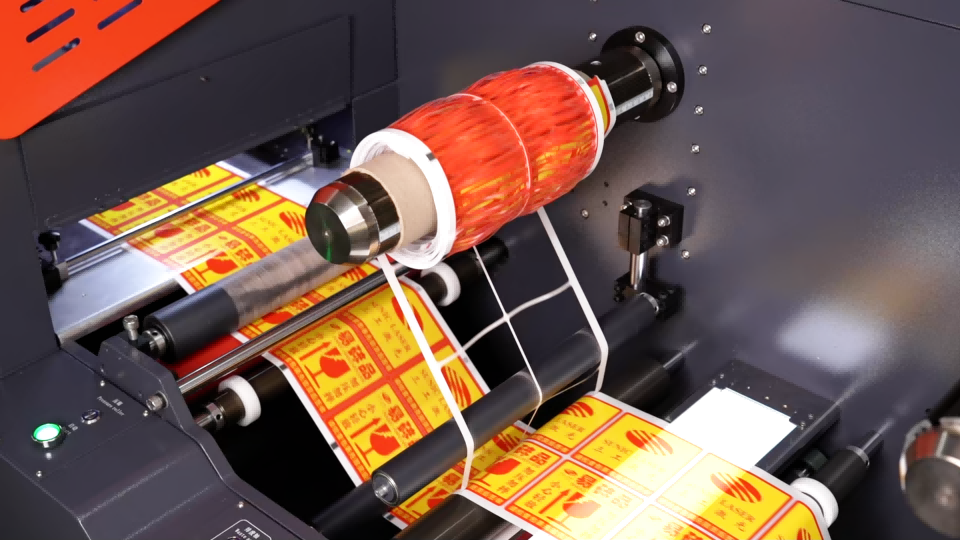
Laser die cutting uses a focused laser beam to cut or kiss-cut material according to a digital design file. Unlike conventional die cutting, it does not require a steel-rule die, flexible die or other physical cutting tool.
Once the cutting file is imported into the control system, the laser follows the programmed path to create the required contour. A new label design can therefore be introduced by changing the digital file rather than manufacturing and installing a new die.
For self-adhesive materials, laser systems can perform several processes, including:
l Label contour cutting
l Kiss cutting without cutting through the release liner
l Perforation and micro-perforation
l Irregular and intricate shape cutting
l Slitting and sheeting
l Cutting of printed labels with registration
l Sequential processing of different jobs
This makes laser die cutting particularly suitable for short and medium runs, customized labels, samples, prototypes and frequently changing orders.
Each cutting method has its own advantages. The best solution depends on the order quantity, material, cutting shape and required production speed.
Comparison | Mechanical Die Cutting | Digital Knife Cutting | Laser Die Cutting |
Cutting tool | Physical die | Blade or knife | Focused laser beam |
Die preparation | Required | Not required | Not required |
Changeover | Die replacement needed | Digital file change | Digital file change |
Complex contours | Limited by die production | Good | Excellent |
Tool wear | Yes | Yes | No physical tool wear |
Short-run flexibility | Limited | Good | Excellent |
Roll-to-roll automation | Mature | Usually limited | Highly suitable |
Kiss cutting | Yes | Yes | Yes, subject to material testing |
Best suited for | Long, repeat orders | Samples and low-volume jobs | Short-to-medium runs and customized production |
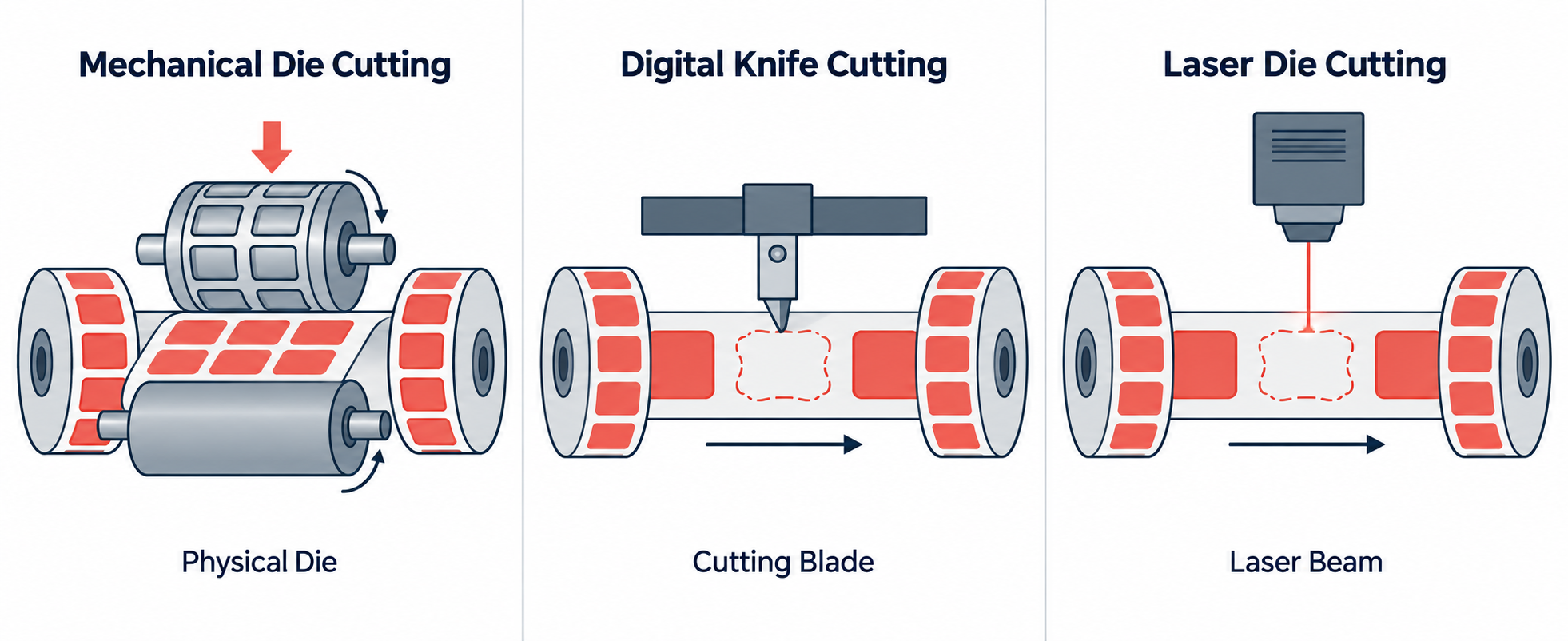
Mechanical die cutting is a proven technology for label converting. It offers high production speed and stable results, especially when the same label design is produced repeatedly in large quantities.
Its main limitation is the physical die. Each new design normally requires a new cutting die, resulting in additional tooling costs, preparation time and die storage. Frequent order changes may also increase downtime and material waste.
For large-volume, standardized orders, mechanical die cutting remains highly competitive. For short runs and frequently changing designs, however, its tooling requirements may reduce overall efficiency.
Digital knife cutting uses a computer-controlled blade to follow the cutting contour. It eliminates the need for physical dies and is commonly used for sampling, prototyping and small production batches.
Compared with mechanical die cutting, it provides greater flexibility. However, blades are subject to wear and may need regular replacement. Cutting very small details, sharp corners or adhesive materials can also be challenging. Productivity may be limited when processing continuous roll materials at industrial scale.
Digital knife cutting is therefore often suitable for proofing and low-volume production, while an automated laser system provides greater potential for continuous roll-to-roll converting.
Laser die cutting is a non-contact process. Because there is no blade or die touching the material, there is no physical tool wear and no pressure-related deformation during cutting.
Its principal advantages include:
l No physical cutting dies
l Rapid changeover between designs
l High flexibility for short and customized orders
l Precise processing of fine details and complex contours
l Reduced die manufacturing and storage costs
l No downtime for blade replacement
l Easy integration with digital workflow systems
l Suitable for automated roll-to-roll production
Laser die cutting does not replace every conventional process. For extremely long runs with one unchanged design, mechanical die cutting may still offer higher output and a lower unit cost. Laser processing results also depend on the material composition, adhesive, liner, coating and printed ink. Sample testing is therefore important before production.
Self-adhesive labels normally consist of a face material, an adhesive layer and a release liner. During kiss cutting, the upper layers must be cut accurately while the liner remains intact.
A properly configured laser system can control the processing depth by adjusting parameters such as laser power, scanning speed and cutting path. This makes it possible to process many paper labels, synthetic labels, adhesive films and other roll materials.
Laser die cutting is especially valuable when producing
l Customized product labels
l Food and beverage labels
l Cosmetic labels
l Pharmaceutical and healthcare labels
l Electronic product labels
l Industrial identification labels
l Promotional stickers
l Security and tamper-evident labels
l Small-batch and personalized labels
l Labels with complex or irregular contours
Manufacturers should conduct material tests because different adhesives, coatings and film compositions react differently to laser energy. Materials that may generate hazardous fumes, such as PVC-containing products, require particular attention and should not be processed without proper material confirmation and fume-control measures.
The development of laser die cutting is no longer focused only on the laser source or cutting speed. Modern label converters increasingly require a complete workflow that connects unwinding, positioning, cutting, waste removal, slitting and rewinding.
To meet this demand, SUNIC LASER has developed a Fully Automatic Roll-to-Roll Laser Die Cutting Machine for self-adhesive labels and flexible roll materials.
The system combines high-speed CO₂ laser processing with automated web handling. Its modular configuration can include:
l Automatic unwinding and rewinding
l Web tension control
l Web guiding and deviation correction
l Printed mark or vision registration
l Label kiss cutting and full cutting
l Automatic matrix waste removal
l Cold lamination
l Slitting
l Sheet cutting
l QR code or barcode reading
l Finished-roll collection
The standard system supports roll materials up to approximately 350 mm in width. Depending on the material, label design and processing requirements, the line speed depends on the material and label design.
Instead of preparing a new die for every label shape, operators can load the corresponding cutting file into the system. With QR code or barcode-based job identification, different designs can be recognized and processed in sequence, helping reduce manual setup and job-change time.
This solution is suitable for converters handling multiple SKUs, short delivery schedules, personalized labels and frequent design changes.
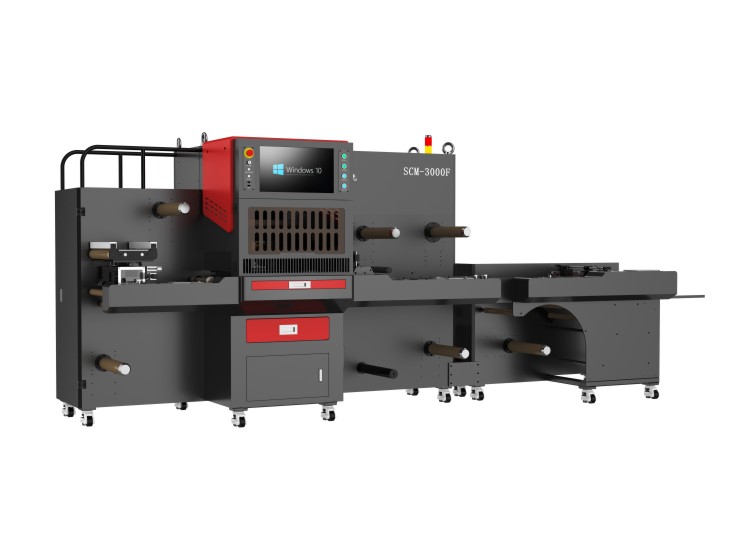
Label shapes are controlled through digital files. Manufacturers can reduce the cost, lead time and storage space associated with physical cutting dies.
Changing from one design to another mainly involves changing the cutting file and production settings. This is particularly useful for short runs and mixed orders.
Unwinding, laminating, laser cutting, waste removal, slitting and rewinding can be integrated into one production line, reducing intermediate handling.
The laser can process small holes, fine details, sharp corners and irregular contours that may be difficult or expensive to produce with conventional dies.
There is no mechanical pressure on the material and no blade wear. This helps maintain consistent processing quality over repeated jobs.
The machine can be configured according to different production requirements, including vision positioning, QR code reading, automatic job switching, lamination, slitting and sheeting.
Brands increasingly require regional versions, seasonal packaging, limited editions and personalized labels. This will continue to increase demand for cutting technologies that can change jobs quickly without physical tooling.
Label production is moving toward connected digital workflows. Printing, laminating, cutting, inspection, waste removal and rewinding will become more closely integrated to reduce manual handling and production time.
Variable job information can be embedded in QR codes or barcodes. The converting system can read the code, select the corresponding cutting file, making production more efficient.
Vision systems will play a greater role in identifying printed marks, compensating for web deviation and improving cut-to-print registration. This is particularly important for digitally printed labels and continuously changing designs.
Die-free processing supports production according to actual order quantities. It can help manufacturers reduce excess inventory, obsolete labels and unnecessary material consumption.
Laser die cutting and mechanical die cutting will continue to coexist. Mechanical dies will remain suitable for stable, high-volume orders, while laser systems will provide greater flexibility for short runs, customized products and complex designs.
The future is therefore not simply a choice between conventional and digital methods. Successful converters will select or combine technologies according to their order structure and production requirements.
Before selecting a cutting system, manufacturers should consider:
l Typical order quantity
l Frequency of design changes
l Material type and thickness
l Label shape and level of detail
l Required cutting depth
l Roll width and production speed
l Printing registration requirements
l Waste removal method
l Lamination, slitting and rewinding requirements
l Future automation needs
For stable, long-run production, conventional die cutting may remain the most economical choice. For short runs, multiple SKUs, intricate designs and rapidly changing orders, automated laser die cutting can provide significant operational advantages.
Laser die cutting is helping self-adhesive label manufacturers respond to a market that demands greater flexibility, faster delivery and more customized products.
By eliminating physical dies and connecting laser processing with automatic roll-to-roll handling, manufacturers can shorten job changeovers, produce more complex label designs and build a more responsive digital converting workflow.
The SUNIC LASER Fully Automatic Roll-to-Roll Laser Die Cutting Machine integrates laser cutting with web guiding, tension control, lamination, waste removal, slitting, sheeting and rewinding. Optional vision and QR code functions further support printed-label registration and automatic job changes.
Because cutting performance varies with the face material, adhesive, coating and release liner, SUNIC LASER recommends testing the customer’s actual material before machine configuration.
Looking for a flexible die-cutting solution for your self-adhesive labels? Contact SUNIC LASER and send us your label material, roll width, cutting design and production requirements. Our team can arrange sample testing and recommend a suitable roll-to-roll laser configuration.
