Search


Current location:Home > News > Industry News
A Practical Buying Guide for Sportswear Manufacturers and Functional Fabric Processors
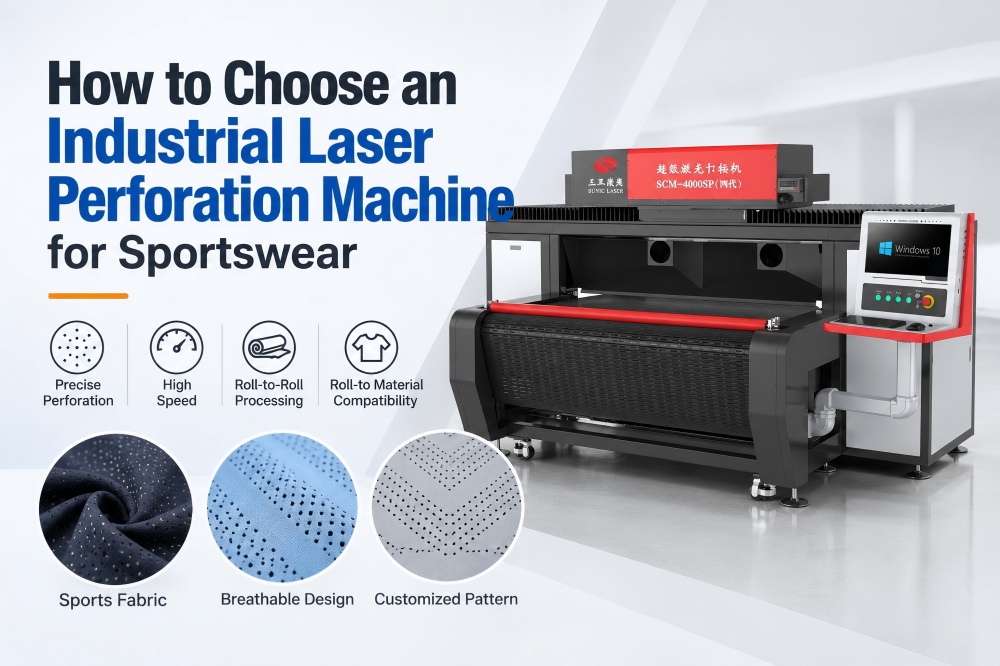
As the demand for lightweight, breathable, and functional sportswear continues to evolve, manufacturers are exploring more flexible ways to create ventilation holes, decorative perforation patterns, and customized fabric designs.
Laser perforation technology offers a non-contact processing method that can produce precise holes and complex patterns without mechanical punching dies.
However, not all laser perforation machines are suitable for industrial sportswear production.
Different machines can vary significantly in laser technology, processing speed, working area, automation capabilities, and long-term operating costs.
Choosing the right sportswear laser perforation machine requires evaluating the actual fabric, hole specifications, production volume, and required processing quality—not simply comparing laser power or advertised maximum speed.
This guide explains the key factors sportswear manufacturers should consider when selecting an industrial laser perforation system, with practical insights from SUNIC LASER's textile processing experience.
Laser perforation is a non-contact process that uses focused laser energy to create holes or patterns in textile materials.
Unlike mechanical punching, laser processing does not require physical punching tools or dies.
Depending on the fabric and laser parameters, laser perforation can be used to create:
Small ventilation holes
Repeated geometric perforation patterns
Gradient perforation designs
Decorative logos and customized shapes
Functional ventilation zones in garment panels
Typical applications include sports T-shirts, running apparel, training garments, cycling wear, performance underwear, and other functional textile products.
For manufacturers producing multiple styles and customized designs, laser perforation can offer greater flexibility than fixed mechanical tooling.
However, the processing result depends heavily on the material composition and laser settings.
Material compatibility should be evaluated before selecting the machine.
CO₂ lasers are widely used for processing many non-metallic materials, including selected synthetic textiles.
Polyester is commonly used in sportswear because of its strength, dimensional stability, and moisture-management potential when appropriately engineered.
Laser perforation can create ventilation holes and decorative patterns in polyester fabrics.
Because polyester is thermoplastic, laser processing may also produce localized melting around the hole edges.
Depending on the fabric construction and processing parameters, this effect can help reduce loose fibers, but excessive heat may cause hard edges, discoloration, or deformation.
Nylon and polyester blends are also used in functional garments.
Their response to laser energy varies according to fiber composition, coating, fabric structure, and thickness.
Materials containing elastane or other stretch fibers require particular attention because excessive heat may affect elasticity and hole shape.
Some sportswear materials include functional coatings, membranes, or laminated layers.
Laser processing may be possible, but manufacturers should verify:
Layer composition
Heat sensitivity
Coating integrity
Hole-edge quality
Ventilation performance
Processing emissions
Important: Not every fabric is suitable for CO₂ laser perforation. Materials containing hazardous additives or chlorine-based components should be reviewed for laser-processing safety before testing.
Fabric weight, commonly expressed in GSM (grams per square meter), is an important reference during equipment evaluation.
For example, sportswear manufacturers may process fabrics in ranges such as:
140–180 GSM for selected lightweight applications
240–280 GSM for selected heavier or structured fabrics
These are examples of customer evaluation requirements, not fixed processing limits.
GSM alone does not determine laser compatibility. Fiber composition, fabric construction, thickness, color, and finishing treatments can all affect processing results.
For this reason, sending representative fabric samples for testing is strongly recommended.
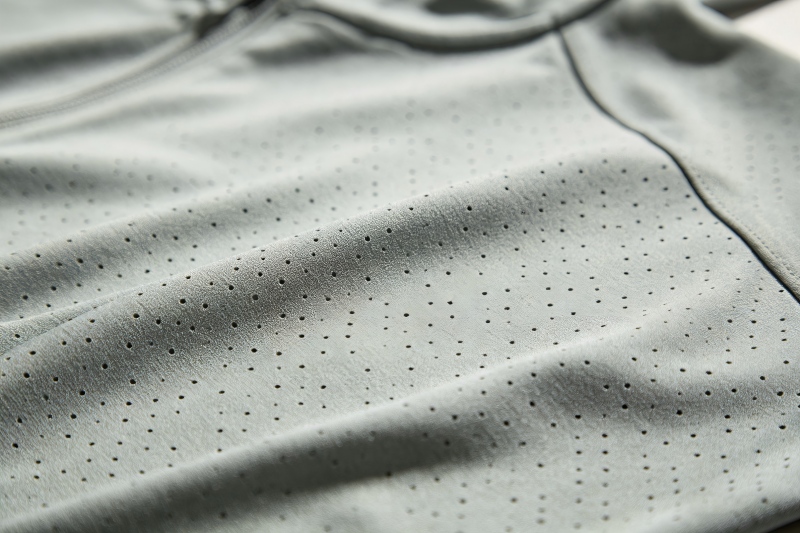
Hole diameter is one of the most important factors in sportswear laser perforation.
Different hole sizes can produce different visual effects and ventilation characteristics.
Common customer-requested nominal hole diameters include:
| Nominal Hole Diameter | Potential Application |
|---|---|
| 0.2 mm | Fine micro-perforation and delicate patterns |
| 0.5 mm | Small ventilation holes and decorative patterns |
| 1.0 mm | Visible ventilation perforation |
| 2.0 mm | Larger ventilation holes and decorative designs |
These dimensions are examples of design requirements rather than guaranteed processing capabilities on every fabric.
The achievable hole size depends on the laser spot, material properties, fabric movement, focusing accuracy, and processing parameters.
For very small holes, manufacturers should also consider:
Hole diameter consistency
Edge melting or charring
Hole spacing
Fabric strength after processing
Stretching and washing performance
Production efficiency
For example, a nominal 0.2 mm hole may be technically achievable on certain materials but may require additional evaluation to ensure stable results during mass production.
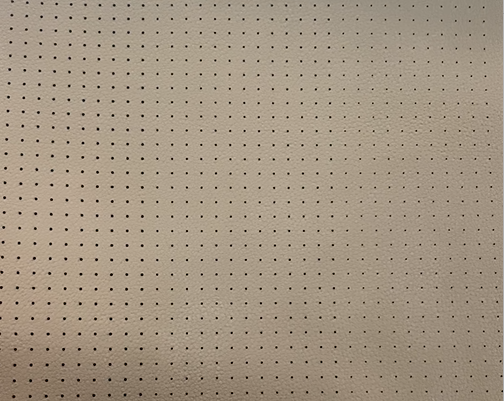
Sportswear manufacturers may encounter two different laser processing approaches.
Conventional laser cutting systems use a mechanically moving laser head to follow cutting paths.
These machines can be suitable for contour cutting, larger shapes, and applications requiring flexible cutting trajectories.
However, when processing dense patterns containing thousands of small holes, mechanical movement and acceleration may limit throughput.
A CO₂ galvanometer laser system uses high-speed scanning mirrors to direct the laser beam across the working field.
This technology is particularly suitable for repeated marking, engraving, and perforation patterns.
Potential advantages include:
High-speed beam positioning
Efficient processing of repeated patterns
Flexible digital pattern changes
No physical punching dies
Compatibility with automated textile handling systems
For large-area textile perforation, a galvanometer system may use field stitching or coordinated material feeding to cover an area larger than a single scanning field.
For dense perforation patterns involving thousands of holes, a CO₂ galvanometer system is often worth evaluating.
For large contour cutting applications, a moving-head system may be more appropriate.
The best choice depends on the actual pattern, material, quality requirements, and production capacity.
The maximum galvanometer scanning speed should not be confused with actual perforation productivity.
Machine specifications such as 10,000 mm/s scanning speed do not mean the laser can continuously process every material at that speed.
Actual production speed must be confirmed through representative sample testing.
Production capacity is often one of the most important purchasing considerations.
Sportswear manufacturers should avoid comparing machines based only on nominal laser power or maximum scanning speed.
Instead, evaluate the time required to complete a specific fabric panel or production pattern.
SUNIC LASER has evaluated large-area composite fabric perforation using different CO₂ galvanometer configurations.
One recorded test involved the following parameters:
| Test Parameter | Specification |
|---|---|
| Material | Composite fabric, 280g |
| Processing area | 1,700 × 1,000 mm |
| Nominal hole diameter | 0.9 mm |
| Pattern spacing | 1.8 mm × 3.6 mm |
| Laser source | RF CO₂ laser |
| Single-head configuration | 250 W |
| Multi-head configuration | Three 250 W laser heads |
Recorded processing times:
Single-head configuration: approximately 34 minutes
Three-head configuration: approximately 11.5 minutes
Under these specific test conditions, the three-head configuration reduced processing time by approximately 66%.
This result illustrates the potential productivity benefit of using multiple laser heads for suitable large-area perforation patterns.
However, these results should not be interpreted as universal processing speeds.
Actual production time varies according to fabric properties, hole density, pattern complexity, machine configuration, and required quality.
For panel-based production:
Productivity (panels/hour) = 60 ÷ Processing Time per Panel (minutes)
For continuous textile processing, manufacturers may prefer to evaluate:
Processed fabric area per hour (m²/h)
Linear processing speed (m/min)
Finished garment panels per hour
Production yield and rejection rate
These measurements should be based on actual production conditions.
For roll-to-roll processing, effective throughput should also account for feeding, positioning, material handling, and any interruptions between processing cycles.
Laser head configuration can significantly influence machine investment and production capacity.
Single-head machines are often suitable for:
Product development
Sample production
Small and medium production batches
Manufacturers with varied designs
Applications with moderate output requirements
They generally involve a lower initial investment than comparable multi-head configurations.
Multi-head configurations can be suitable for manufacturers processing large areas or repeated patterns at higher production volumes.
Potential advantages include:
Parallel processing
Reduced processing time for suitable patterns
Increased production capacity
Greater flexibility in large-area processing configurations
However, multi-head systems also require careful consideration of working-area allocation, field stitching, synchronization, maintenance, and investment cost.
More laser heads do not automatically guarantee proportional productivity gains.
A practical equipment evaluation should compare the required output against the additional investment.
Sportswear manufacturers should also consider how materials will be handled during production.
Manual or semi-automatic configurations may be suitable for:
Sampling
Short production runs
Pre-cut fabric panels
Frequent material changes
Lower automation budgets
These systems can offer flexibility when production volumes are relatively low.
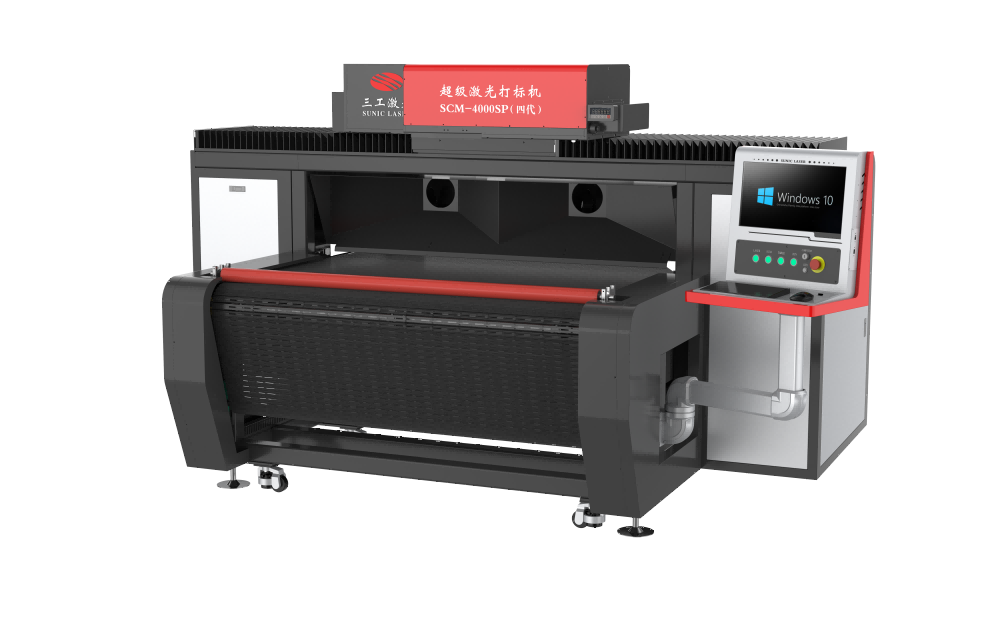
Roll-to-roll laser perforation systems are designed for processing continuous fabric rolls.
Depending on the configuration, an automated system may include:
Fabric unwinding and rewinding
Controlled material feeding
Tension management
Positioning and alignment
Continuous or indexed laser processing
Customized pattern control
For manufacturers processing fabrics approximately 1.6 meters wide, machine working width and feeding accuracy are particularly important.
Automated systems can help reduce manual handling and support more consistent production workflows.
However, buyers should confirm the actual usable processing width, supported roll dimensions, feeding accuracy, and compatibility with their fabric characteristics.
Industrial CO₂ laser perforation machines are available with different power configurations.
For example, SUNIC LASER offers selected RF CO₂ galvanometer systems with 250 W and 350 W laser source configurations, as well as customized multi-head solutions.
Higher laser power may provide additional processing capacity for certain materials and applications.
However, higher wattage does not automatically produce better hole quality or proportionally faster production.
Machine selection should consider:
Fabric composition and thickness
Required hole diameter
Pattern density
Processing area
Desired production speed
Edge quality requirements
Laser source characteristics
For fine perforation, excessive laser energy may create undesirable melting, discoloration, or enlarged holes.
The most appropriate laser power should therefore be determined through sample testing rather than nominal specifications alone.
Industrial laser equipment should be evaluated as a long-term production investment.
The purchase price is only one part of the overall cost.
Manufacturers should also consider:
Laser source lifespan and maintenance
Energy and cooling requirements
Operator labor
Material waste
Production downtime
Replacement parts
Technical support
Production output
A useful approach is to estimate the processing cost per acceptable finished panel.
Processing Cost per Panel = Total Operating Cost ÷ Number of Acceptable Finished Panels
This helps manufacturers compare equipment using actual production results.
For example, a higher-investment laser system may become economically attractive if it reduces processing time, manual labor, and rejected products.
However, the financial benefit depends on production volume, utilization rate, labor costs, and operating conditions.
Manufacturers should request actual sample testing and production estimates before making an investment decision.
Before purchasing a sportswear laser perforation machine, manufacturers should prepare a clear list of requirements.
What fabric composition will be processed?
What is the fabric GSM?
Is the material coated, laminated, or elastic?
What is the maximum fabric width?
What hole diameters are required?
What is the hole spacing?
Are gradient patterns or logos required?
What is the maximum processing area?
What edge quality is acceptable?
How many panels or square meters must be processed per hour?
Is roll-to-roll automation required?
Will the machine process one design or multiple designs?
How frequently will production patterns change?
What training is provided?
Are spare parts available?
Can technical support be provided remotely?
What are the warranty and on-site service terms?
A supplier should be able to discuss these requirements and arrange representative material testing before final machine selection.
SUNIC LASER develops industrial CO₂ galvanometer laser solutions for textile perforation, engraving, and customized material processing.
Our equipment configurations include industrial RF CO₂ laser sources, high-speed galvanometer scanning technology, and application-specific material handling options.
Depending on production requirements, available solutions may include:
Compact CO₂ galvanometer systems
Large-area fabric processing configurations
Automated roll-to-roll solutions
Customized multi-head systems
Pattern processing for ventilation holes, logos, and decorative designs
For sportswear applications, our team focuses on evaluating the relationship between fabric characteristics, perforation quality, processing efficiency, and production requirements.
Rather than selecting a machine solely by laser wattage, we recommend testing the customer's actual material and design.
SUNIC LASER also provides technical consultation, sample evaluation, operator training, and after-sales support for international customers.
https://www.suniclasertech.com/automation/29.html
Yes, many polyester fabrics can be processed using CO₂ laser technology. However, fabric construction, thickness, coatings, and heat sensitivity influence the final result. Sample testing is recommended.
Small holes may be achievable on suitable materials with an appropriately configured laser system. Actual hole diameter and consistency must be verified through testing.
It depends on the application. Galvanometer systems can be efficient for flexible, digitally controlled patterns, while dedicated mechanical punching systems may offer advantages for certain fixed, repetitive patterns. A fair comparison requires identical materials, patterns, and quality requirements.
No. Higher power can provide additional processing capacity in some applications, but actual speed depends on the fabric, hole dimensions, optical system, and required quality.
Yes, suitably designed large-area or automated roll-to-roll systems can support this requirement. The actual usable processing width and feeding configuration should be confirmed with the supplier.
Measure the actual processing time for a representative fabric panel or roll length. Then calculate panels per hour, square meters per hour, or linear meters per minute, including material handling time where applicable.
A single-head system may be more economical for sampling and moderate production volumes. Multi-head systems can offer higher throughput for suitable large-area patterns, but the investment should be evaluated against actual production requirements.
Selecting the right industrial laser perforation machine for sportswear requires a complete understanding of the material, hole specifications, production capacity, and automation requirements.
A suitable system should deliver consistent perforation quality while meeting the manufacturer's productivity and operating-cost targets.
For high-volume textile perforation, industrial RF CO₂ galvanometer systems are an important technology to consider, particularly when precise patterns and automated material handling are required.
The best machine is not necessarily the one with the highest laser power or advertised speed, but the one that consistently meets your actual production requirements.
Are you evaluating laser perforation for sportswear, performance fabrics, or garment accessories?
Share your fabric samples, GSM, required hole diameters, pattern files, fabric width, and production targets with SUNIC LASER.
Our technical team can help evaluate a suitable machine configuration and arrange sample testing.
SUNIC LASER — Industrial Laser Processing Solutions
Website: https://suniclasertech.com
